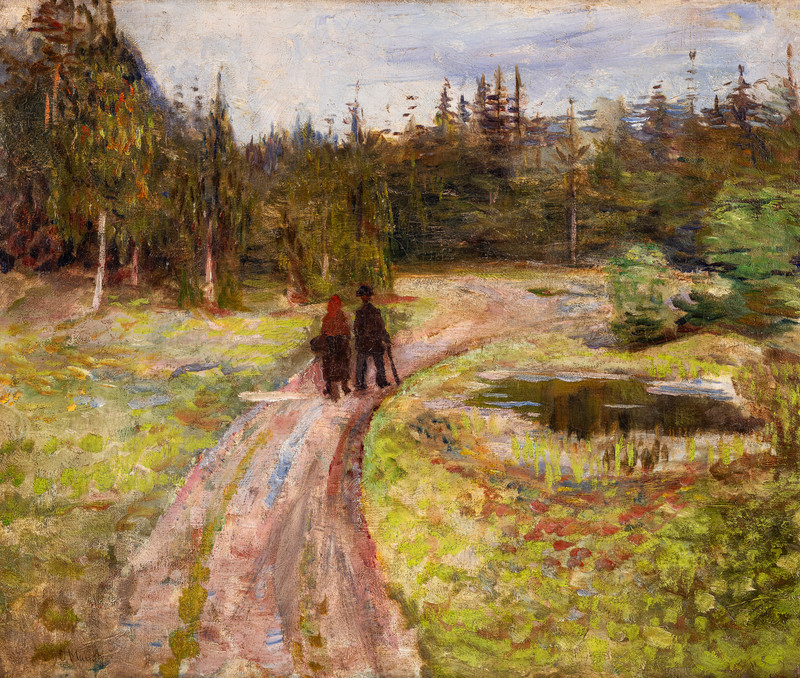
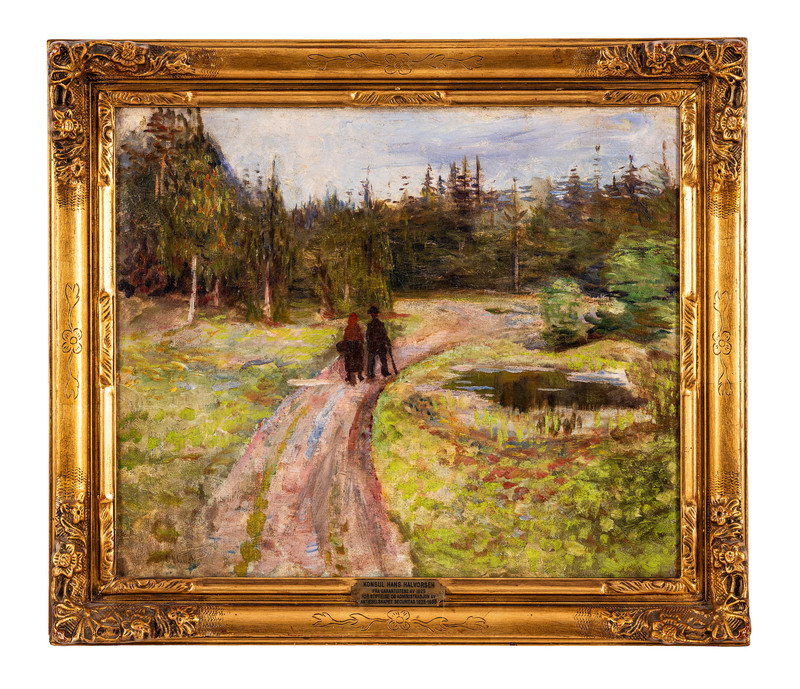
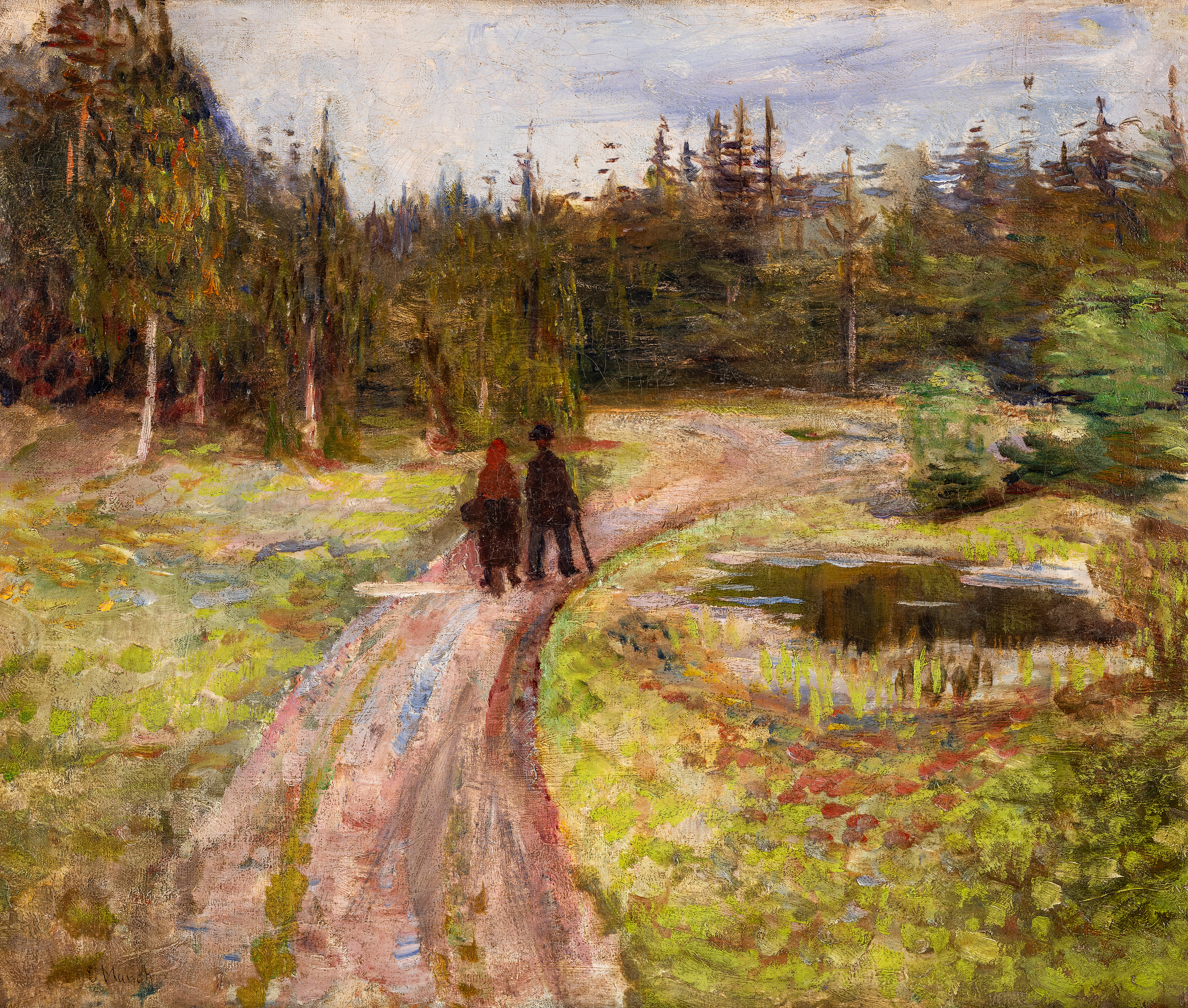
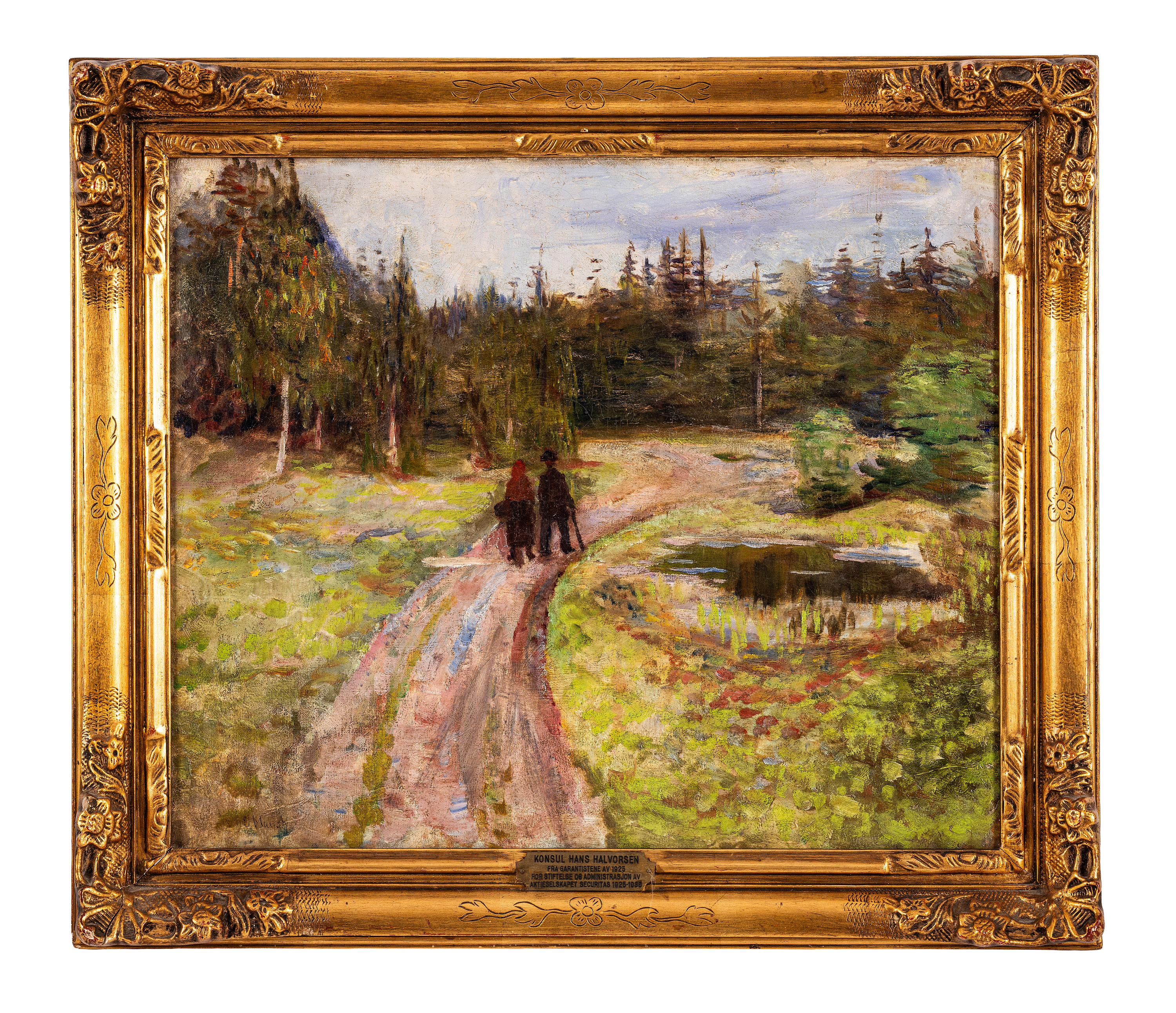
Two on the Way to the Forest 1884
The period 1880-1885 is regarded as Munch's early formative years. The young artist drew his motifs from his immediate surroundings, with a clear influence from French painting.
In 1880, Munch entered the art world when he enrolled at the Royal Drawing School in Kristiania. There he worked systematically for the first time from live models. The teaching awakened something in him, and his artistic talent came fully to the fore. Together with fellow artists, he went out to paint the subjects around him: the factories along the Akerselva river, the street life of Karl Johan, and the landscapes on the outskirts of the city. In time, Munch rented a studio with several other young artists in "Pultosten" (the Cheese Wedge). There he met the established painter Christian Krohg, who became an important mentor. Krohg encouraged the young artist to seek his own expression and to challenge the artistic conventions of the day.
Munch found a sense of belonging among the young naturalists who sought out and painted their motifs outdoors, inspired by Fritz Thaulow. However, he distinguished himself from the group at an early stage through greater experimentation in his handling of brushstrokes and light. In the summer of 1883, Munch took part in Thaulow's first open-air academy at Modum. The group of artists participating looked to French plein-air painting, both technically and thematically. At the Autumn Exhibition, Munch showed the painting Morning Chores (1883). The following year he exhibited Morning (1884), and the breakthrough was a fact.
In the period 1877-1882, Munch visited his father at the Helgelandsmoen military camp, where he worked as an army doctor. During his stay in the summer of 1882, he painted The Sick Ward at Helgelandsmoen, one of the early works that demonstrates his great interest in light, colour and atmosphere. In the painting, the shifting effects of light are rendered with great sensitivity, through fine nuances and lively brushstrokes that lend the interior a shimmering atmosphere. The painting's warm colours and cohesive colouring show that Munch followed contemporary international art closely. At the same time, we can see features that foreshadow the artist Munch would later become: already here he experiments with how human beings can be conveyed through a simplified form within a composition. Such figure forms would later become an important device in some of his best-known works.
Two on the Way to the Forest 1884 has previously been given various dates. Closer analysis shows that the canvas used corresponds to materials used in 1883. According to an inscription on an index card in the Munch Museum, it was probably painted at Gardermoen, possibly during a visit to Helgelandsmoen in the summer of 1884. The composition of the motif, with two figures moving as a single unified form towards a forest, is a recurring pictorial language in Munch's graphic work and painting throughout his career.
Text by Luisa Aubert