Munch’s Vampire Motif: The Paradox of Love
Munch’s Vampire is arguably one of the most enigmatic images of love in art history. The artist himself rejected the interpretation that would later make the work famous. “Vampire is really what makes the picture literary; in reality it is merely a woman kissing a man on the neck,” Munch wrote. Nevertheless, it was precisely the vampire narrative that attached itself to the motif, and which has made the image a symbol of the notion of the deadly femme fatale.
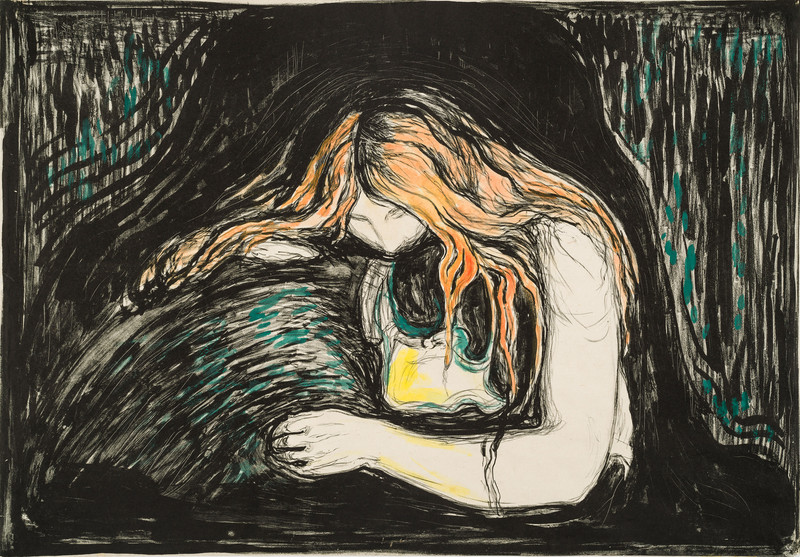
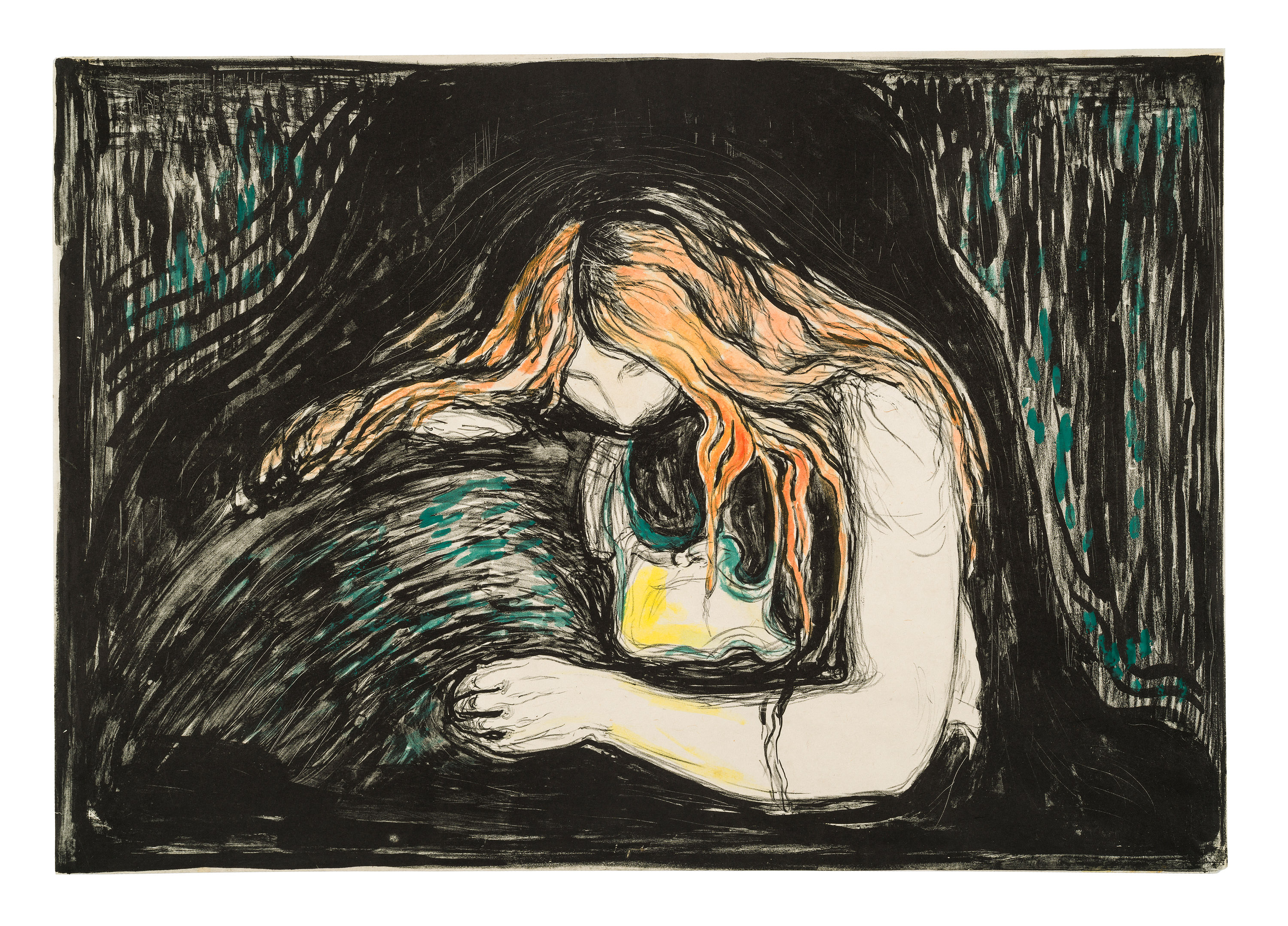
When Munch painted the first version of the motif in Berlin in 1893, he gave it the title Love and Pain. The picture shows a woman with flaming red hair bending over a man. She enfolds him in her arms and lets her hair fall around his body like a dark veil. At first glance, the scene can be read as a moment of tenderness and consolation. On closer inspection, however, an ambiguity emerges in the relationship between the two. What kind of love are we witnessing here? Is this the image of a loving woman protecting a despairing man, or is she a creature slowly devouring him?
The motif hovers between love and destruction, between desire and submission. When the work was later given the title Vampire, the darker interpretation was reinforced. In myth and folklore, the vampire is not merely a monster, but a creature that feeds on the life force of others. It returns from the dead and nourishes itself on the blood of the living. The fear is not only of death, but of being drained of strength, will and identity by another. In Munch’s depiction, the man is the victim: he sits hunched and faceless in the woman’s embrace, almost lost in her presence. The Polish writer Stanisław Przybyszewski described the motif as “a man broken in spirit,” while the woman’s face appears as a biting vampire at his neck.
This fear of the seductive and destructive woman was widespread in European culture around the turn of the century. The notion of the femme fatale, the fateful woman who lures men to their doom, appeared in literature, art and popular culture across Europe. In Munch’s time, red hair was often associated with this figure. The red-haired woman was seen as passionate, dangerous and uncontrollable. Munch deliberately exploited these cultural conceptions, and in Vampire the woman’s red hair becomes almost a symbol in its own right. The hair flows over the man like blood, fire or a net from which he cannot escape. The man seems to lose himself in the encounter with the woman.
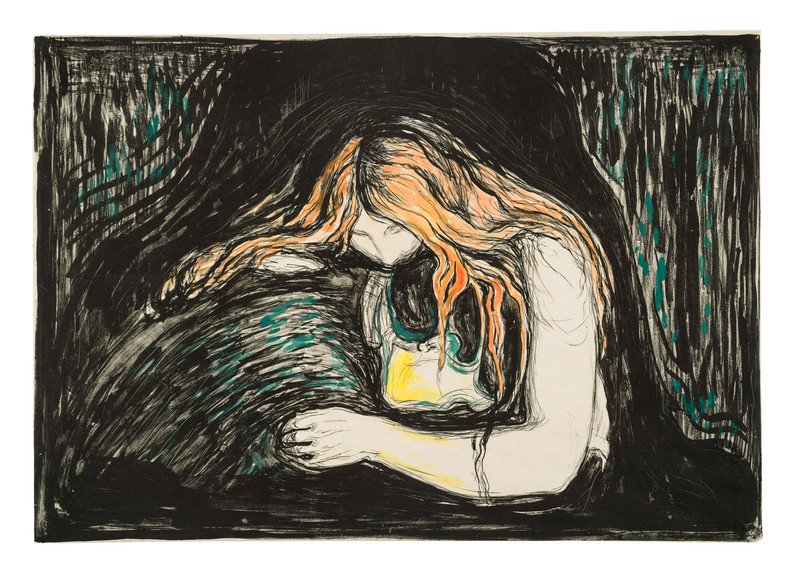
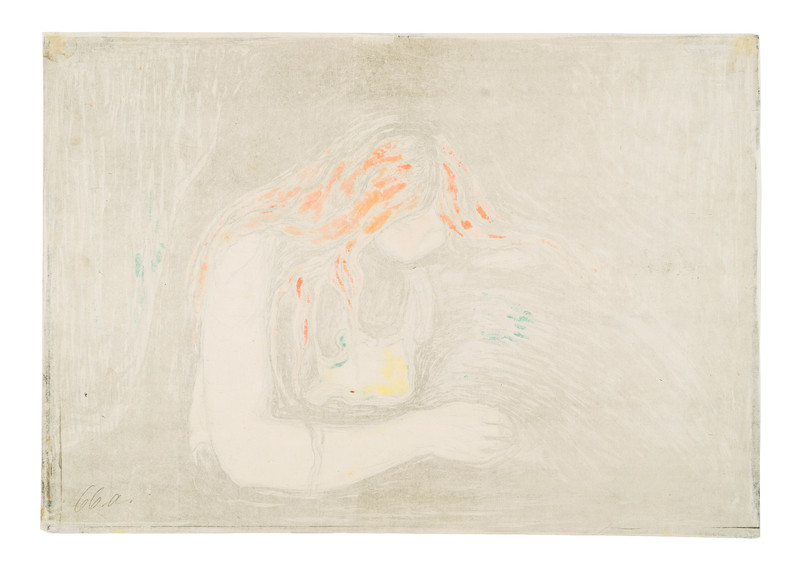
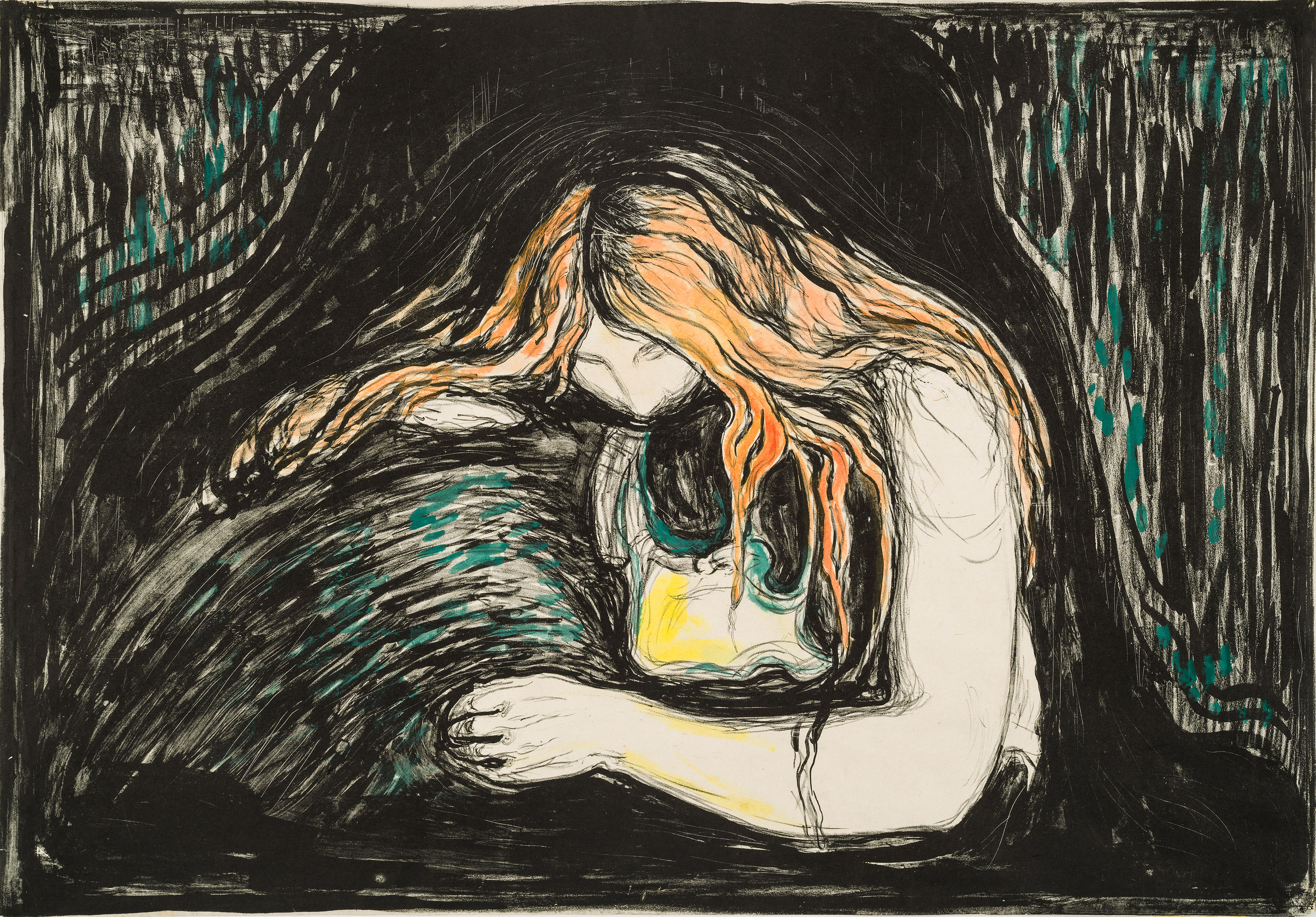
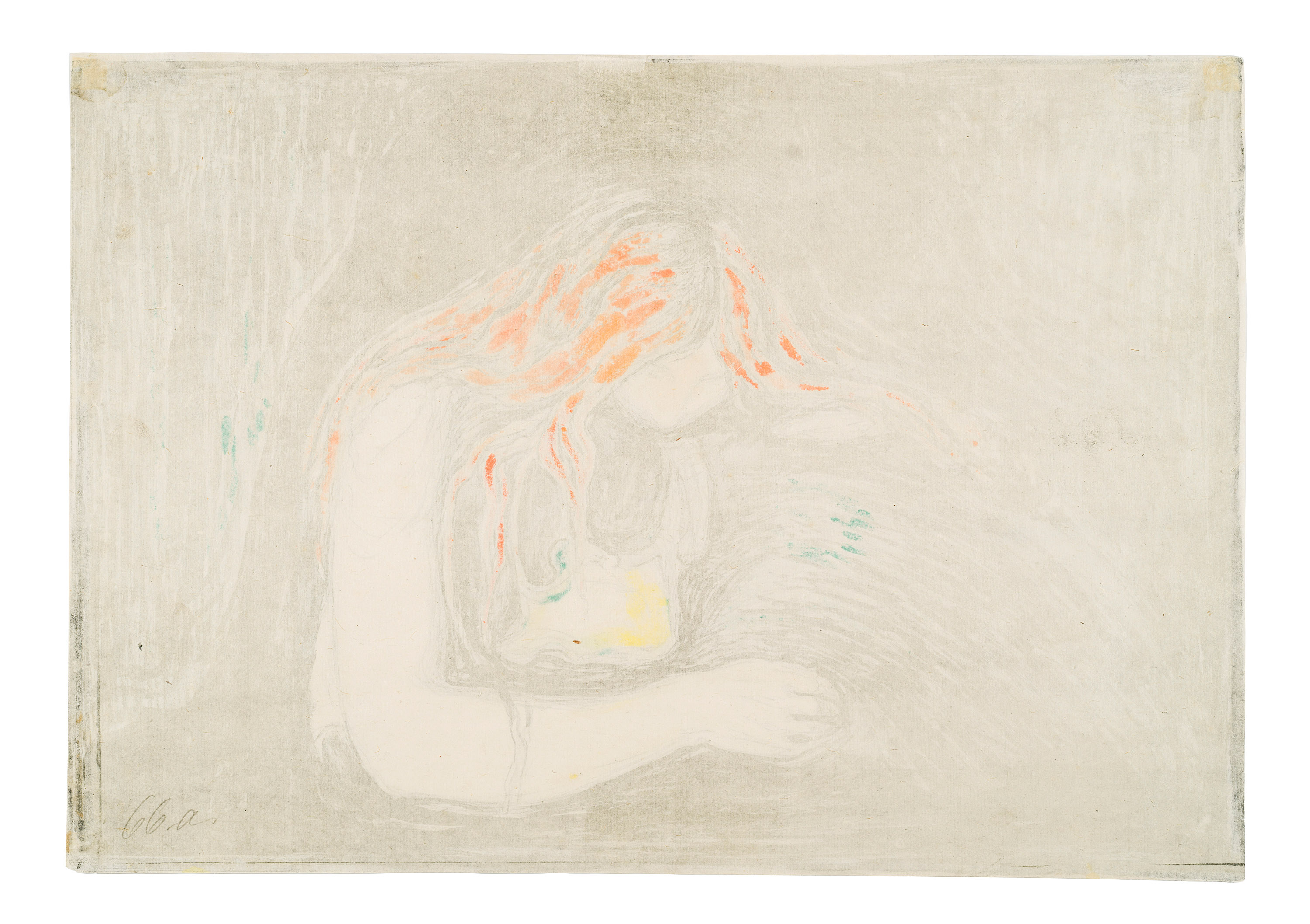
That Munch repeatedly returned to the vampire motif underscores its significance. As early as 1895 he produced the first graphic versions of Vampire, and around 1902 he developed the motif further in the multicoloured sheet Vampire II, in which lithography and woodcut are combined. Through these graphic techniques he was able to heighten the contrast between the dark head of the man and the woman’s glowing hair, thereby emphasising the tension of the motif.
The Vampire motif expresses Munch’s lifelong interest in the paradoxes of love: the woman may be interpreted as a vampire draining the man’s life force, but she may equally be seen as a lover seeking to console him. The tension within the motif lies between embrace and attack, between kiss and bite.
Text by Luisa Aubert