Alpha and Omega: A Burlesque Love Story By Luisa Aubert
The Portfolio and Its Technique
Edvard Munch’s print portfolio Alpha and Omega comprises eighteen principal compositions, two introductory vignettes, a title page and a table of contents.
The dating of the portfolio has varied over time. At an exhibition in Houston in 1976, the lithographs were dated to 1896. This attribution was based on stylistic characteristics, the psychological nature of the subjects and the use of contrasts, all of which corresponded to other works produced by Munch during that year. Munch’s cousin, the artist and prolific diarist Ludvig O. Ravensberg, noted that Munch had already begun developing preliminary sketches for the compositions at this time. This may explain the stylistic affinities between the portfolio and works from the same period. Further evidence can be found in one of Munch’s sketchbooks from 1895, which contains compositional parallels to several motifs in Alpha and Omega, including studies for Woman on the Shore, Man at the Edge of the Forest and Man Drowning Woman on the Shore.
Arne Eggum maintained that Munch had conceived the idea for such a portfolio as early as the 1890s. Nevertheless, within Munch scholarship, 1904 is generally regarded as the earliest date by which the project had developed into a complete pictorial series. Munch himself considered the portfolio an important undertaking and actively sought to promote it among his acquaintances. He received considerable support from his friend and advocate Gustav Schiefler, who also contributed to the cataloguing of Munch’s graphic work. Schiefler believed that the series originated during Munch’s stay in the seaside resort of Warnemünde in 1908. At that time, Munch referred to the compositions as The First Humans. The sketches shown to Schiefler in Warnemünde correspond iconographically with the Alpha and Omega portfolio of 1908–09. In 1910, Schiefler presented the portfolio in an extensive article published in Kunst und Künstler.
The series was initially conceived primarily as a combination of woodcuts and etchings. Munch ultimately chose, however, to execute the compositions as transfer lithographs. According to Gerd Woll, this decision may be explained by the technical advantages of transfer lithography, particularly the fact that the artist did not need to be present during the printing process. This was an important consideration, as Munch had been admitted to Dr Daniel Jacobson’s clinic in Copenhagen in the autumn of 1908, following a nervous breakdown. Transfer lithography enabled him to draw the individual compositions on paper, which could subsequently be transferred to lithographic stones. The technique also allowed him to work en plein air, freeing him from the need to draw directly onto heavy lithographic stones in a workshop.
During his stay in Copenhagen, Munch visited the zoological gardens, where he made studies of tigers, lions, bears and monkeys. These animal motifs were eventually incorporated into the Alpha and Omega portfolio. Ravensberg’s diary entries confirm that the animal studies Munch produced during his time at the clinic were intended for the portfolio. They also indicate that his approach to these studies was academic and conventional. When the Copenhagen printing house planned to grind down the lithographic stones bearing the compositions after printing, Munch arranged for the images to be transferred back onto transfer paper, enabling them to be mounted onto new stones in Norway. In addition to the compositions included in the portfolio, Munch produced several further motifs that could have formed part of the narrative: The Serpent, Towards the Forest and Omega and the Bear. These additional works are believed to have been printed in approximately the same edition size as the first edition of the portfolio. They were not, however, incorporated into the definitive sequence when Munch transferred the compositions onto the new stones.
A Gesamtkunstwerk
Munch was well versed in history, particularly its literary traditions. The narrative of Alpha and Omega is closely connected to the ancient tragedies of Aeschylus and Sophocles. This relationship is especially apparent in the use of a satyr's head on the portfolio’s title page. The masks of Tragedy and Comedy are also said to share characteristics with several of Munch’s self-portraits. The text accompanying the prints occupies a central position within the portfolio, demonstrating how Munch throughout much of his life explored various literary genres alongside his visual art. The portfolio constitutes a Gesamtkunstwerk, an integrated work of art in which image and text form a unified whole. Munch is also believed to have reused passages from the portfolio’s text in later exhibition catalogues.
Two literary drafts for the prose poems in Alpha and Omega have survived. Both explore the idea of a new world emerging in the aftermath of a catastrophe. One is a paraphrase of the biblical story of Adam and Eve in Paradise. The other is more explicitly connected to Munch’s own contemporary intellectual climate and philosophical ideas, including Friedrich Nietzsche’s concept of eternal recurrence. When Munch wrote to Schiefler in 1909, both texts were presumably still intended for The First Humans:
“I have called the two people Alpha and Omega. I no longer had the sketches you saw, and therefore the compositions have turned out somewhat differently. Moreover, I could not resist portraying my dear enemies in the various animal forms.”
The Story of Alpha and Omega
Munch frequently drew upon familiar surroundings in his compositions, as he had done when developing the Frieze of Life during the 1890s. Two years earlier, Munch had stayed on Veierland, an island off the coast of Tønsberg in southern Norway. It is here that he situated the story of Alpha and Omega. On one impression of the print Satyr’s Head with Clenched Fists, Munch wrote:
“Alpha and Omega. The action takes place in prehistoric times on the island of Veierland in southern Norway. Alpha and Omega are the island’s first human beings.”
The portfolio presents a burlesque narrative conveyed through a sequence of images. The story may be interpreted as offering a negative portrayal of women, particularly when viewed through a feminist perspective. Its themes encompass death, anxiety, innocence, eroticism, loneliness and longing. In this portfolio, we encounter Munch not only as an artist but also as a philosopher. Jealousy and passion have always formed part of the enduring spectrum of human emotions, and the narrative continues to resonate with contemporary audiences. Several of the compositions incorporate motifs familiar from Munch’s wider oeuvre. One example is Alpha’s Despair, in which the protagonist raises his hands to his face in a gesture of anguish, echoing the expression of despair in The Scream. His cry reverberates throughout the surrounding landscape, translated into undulating lines across the sky and sea. Munch writes:
“He ran along the shore; the sky and the sea were coloured with blood; he heard screams in the air and held his hands over his ears; the earth, the sky and the sea trembled, and he was overcome by a profound sense of anxiety.”
The deeply tragic narrative of Alpha and Omega offers no happy ending. It may, however, be understood as a testament to art’s capacity to instruct and enlighten the viewer through the protagonist’s experience and subsequent catharsis, in the tradition of Greek tragedy.
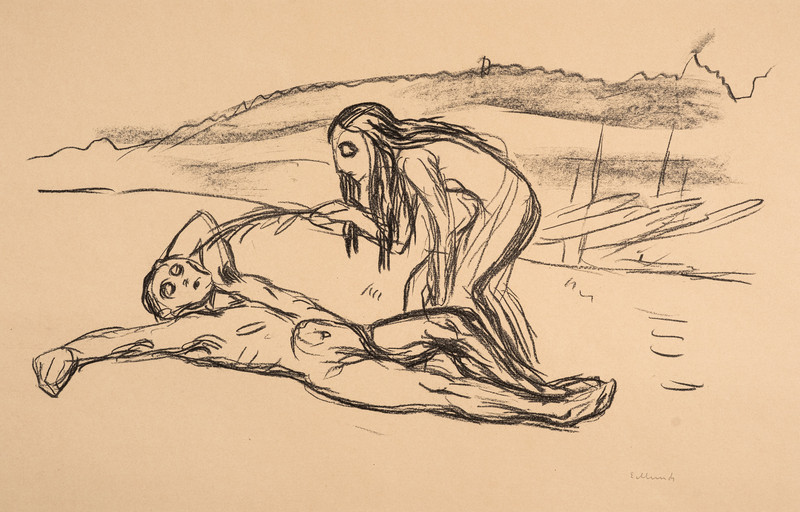
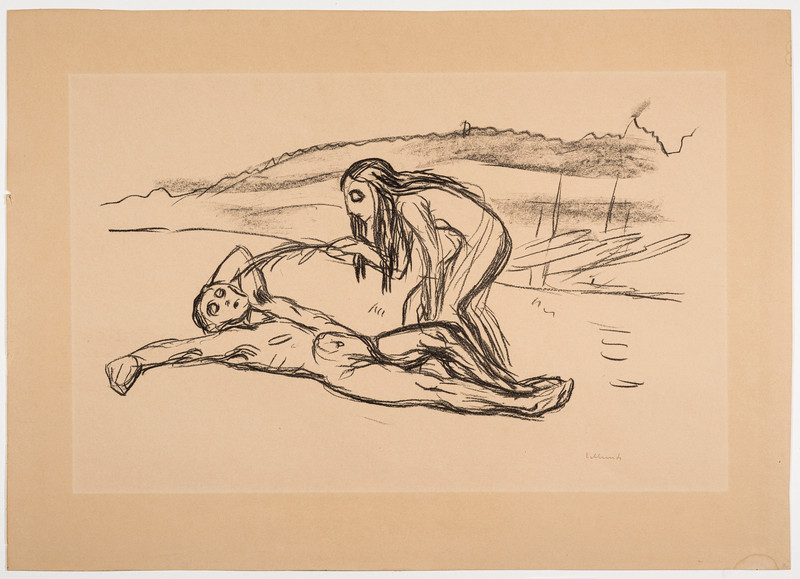
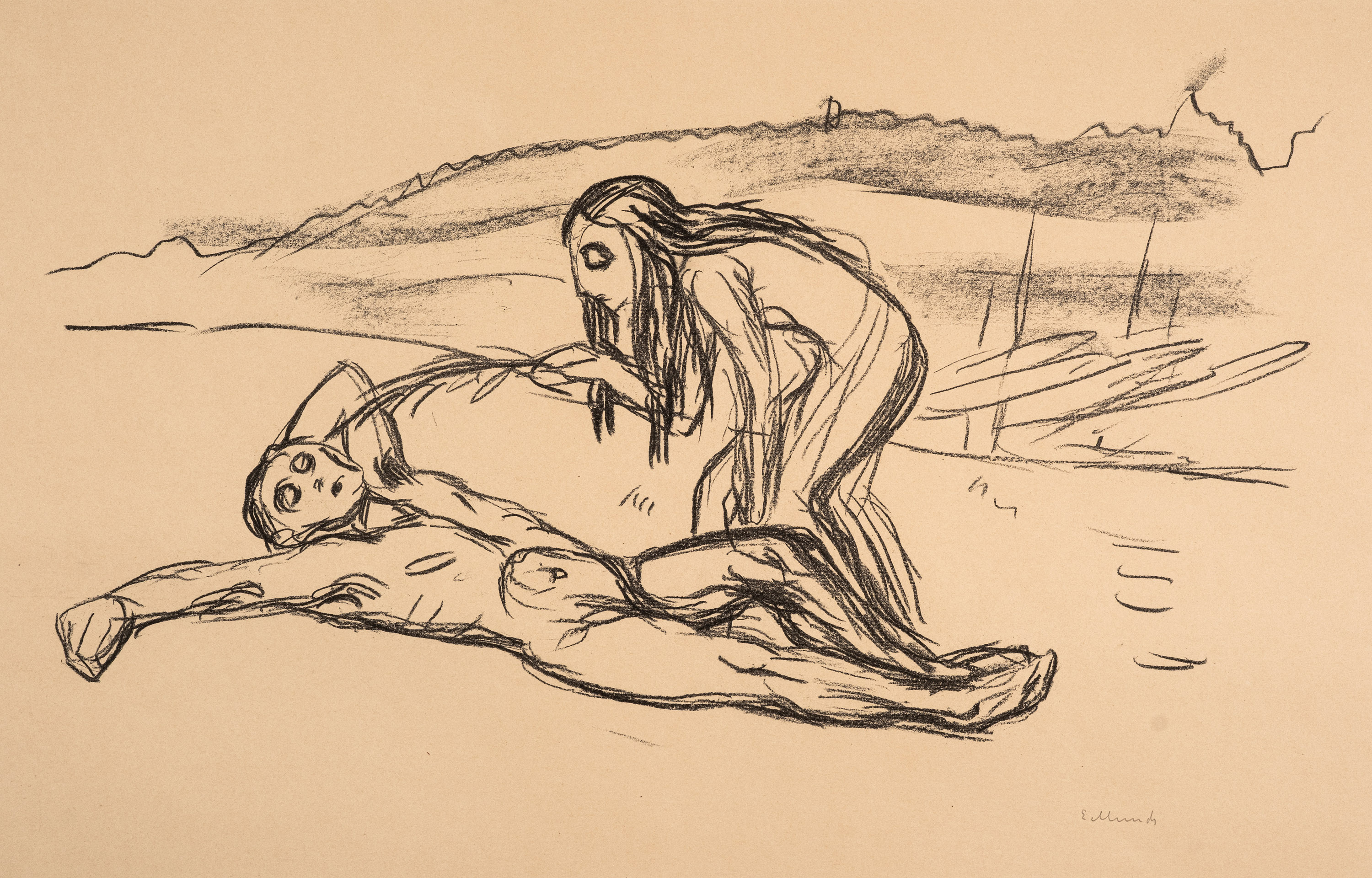
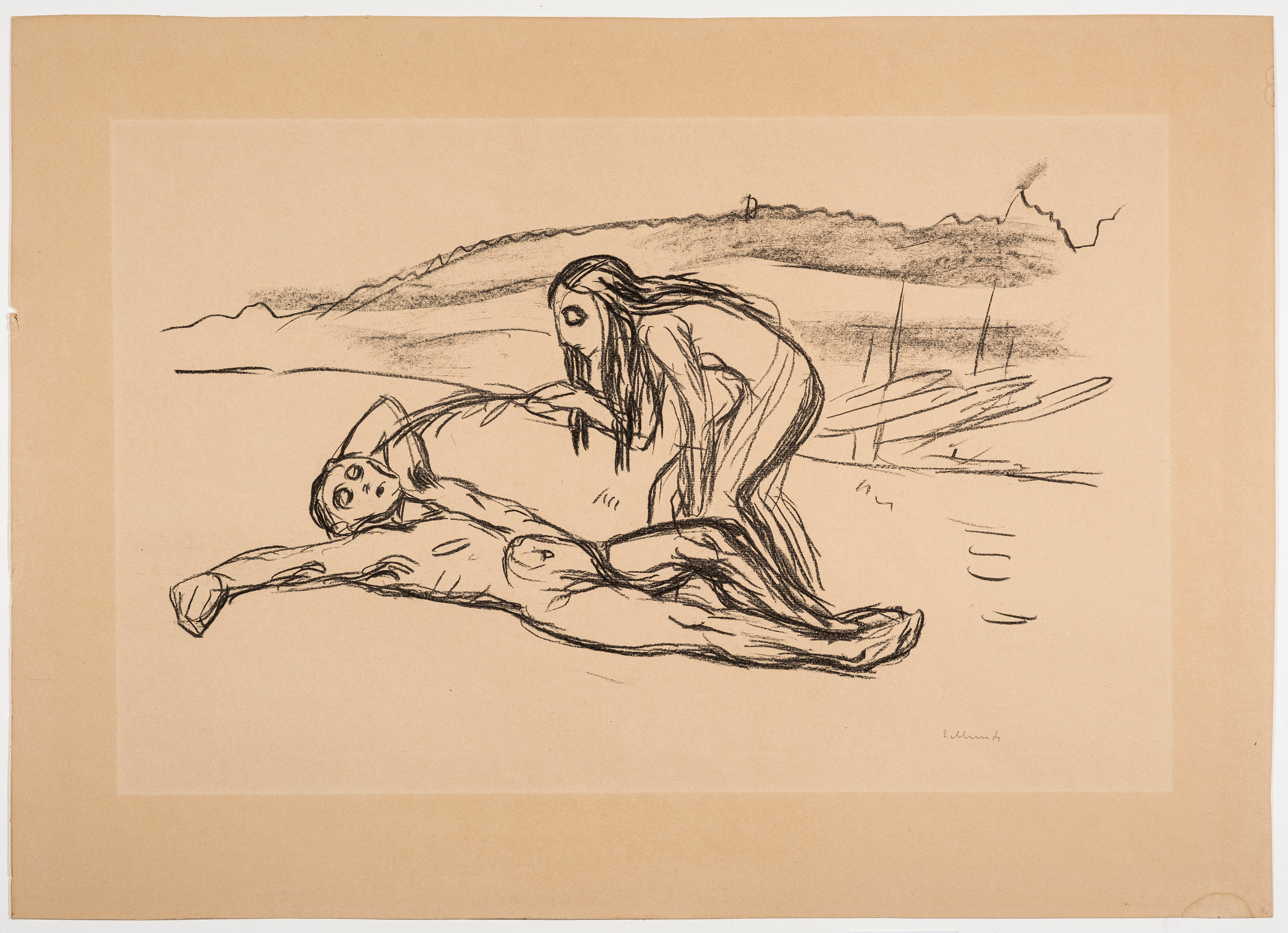
“One day the roe deer brought Omega back. Alpha was sitting on the shore, and she came towards him. Alpha felt the blood rushing in his ears; his muscles swelled, and he struck Omega, killing her. When he bent over the dead woman and looked at her face, he was horrified by its expression. It was the same expression she had worn in that moment in the forest, when he had loved her most.”
The story concludes with Alpha’s death, which paves the way for a new generation to emerge and, perhaps, to redeem the original sin:
“While he was still looking at her, all her children and the animals of the island attacked him from behind and tore him to pieces. The new generation populated the island.”
Could the narrative be interpreted as Munch’s critique of the Kristiania Bohemians’ ideal of free love? The subject appears to have held a particular fascination for him. Munch had previously written the play The City of Free Love, whose cast of characters bore similarities to individuals with whom he had already developed strained relationships, including Gunnar Heiberg, Tulla Larsen and Sigurd Bødtker. One of the principal differences between the earlier Two Human Beings and Alpha and Omega is that the female protagonist in the latter repeatedly changes appearance. One interpretation is that these variations represent different female types and, by extension, different women in Munch’s own life. Another suggests that the figures were inspired by his relationships with Dagny Juel or Tulla Larsen, both prominent women in Munch’s biography.
Munch himself, however, denied such personal associations. Furthermore, the depiction of Omega bears little resemblance to the way he portrayed Tulla Larsen between 1902 and 1911, notably as the femme fatale figure Salome in a number of caricatures. In a letter to Jens Thiis, Munch explicitly rejected a personal reference in the figure of Omega, explaining that the female figures in The Tiger and Alpha and Omega were based on the same model as those in his lithographs Madonna and The Wave from the 1890s. Munch himself held an unwavering belief in the success of Alpha and Omega. Writing to Ravensberg in 1910, he declared:
“They are my finest works. I think this is the most complete thing I have ever done ...”
His conviction in the importance of the lithographic portfolio was also shared by the artist and print connoisseur Johan Herman Struck, who offered the following assessment:
“All these sheets (that is, the prints) radiate a peculiar, mysterious humour and reveal, to those capable of seeing, the artist’s thoughts on woman’s eternal infidelity. When contemplating them, one is reminded of Strindberg, particularly The Defence of a Fool. The drawings are extraordinarily refined in their economical use of artistic means and their effective distribution of powerful contrasts; yet they also possess something of the hesitant simplicity of the primitive scribblings carved by prehistoric man into rock faces.”
Further Reading:
Omega’s Eyes: Marlene Dumas on Edvard Munch. MUNCH Museum, 2018–19.
Edvard Munch: Alpha and Omega. Munch Museum, 1981.