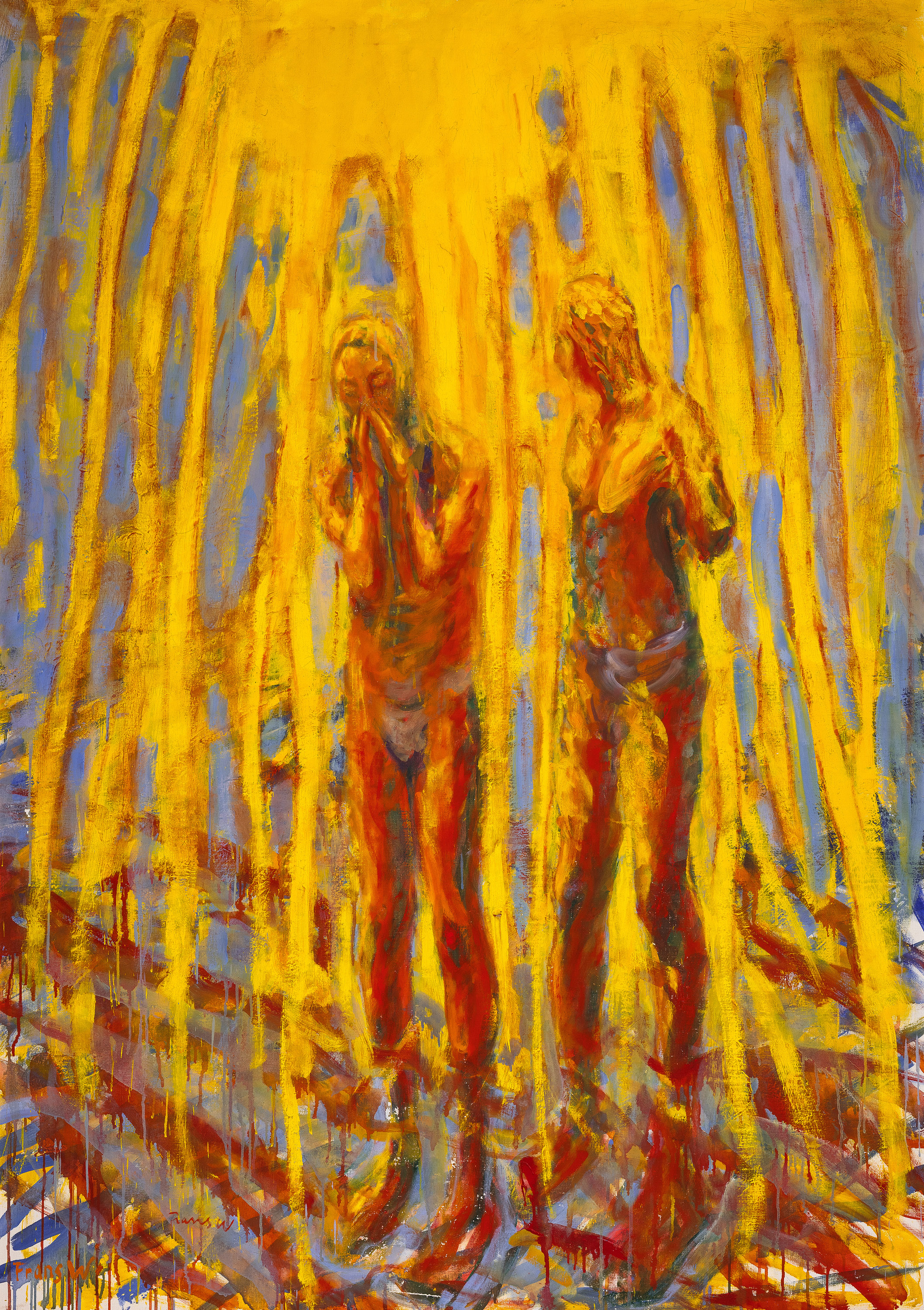
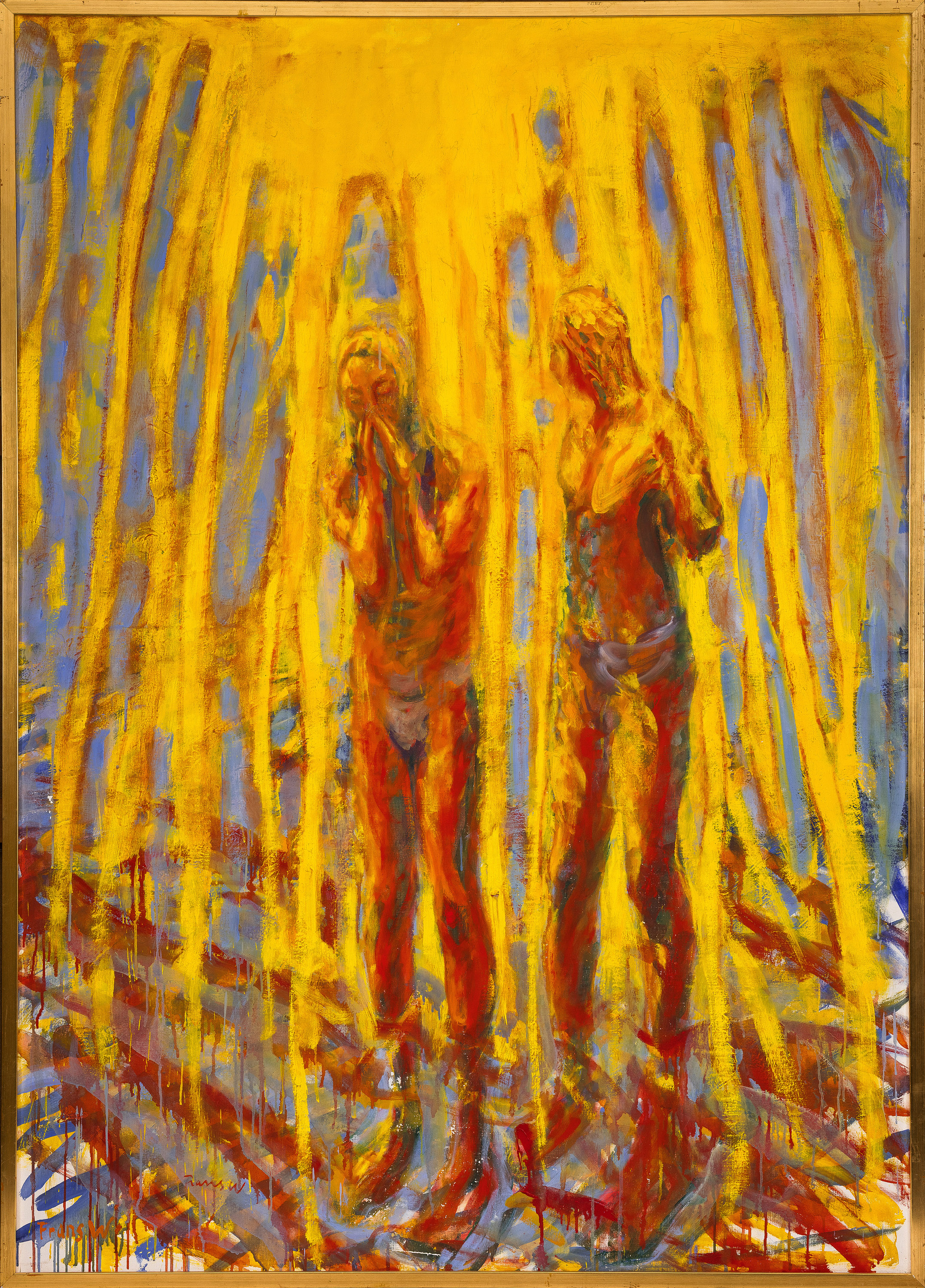
Johns' Baptism, 1974
Frans Widerberg (1934–2017) is regarded as one of Norway’s most prominent post-war artists. Throughout his career, he explored profound questions concerning life, humanity’s place in the world, and the relationship between the visible and the invisible. At a time when abstract art dominated the art scene, Widerberg chose to pursue a figurative approach.
Widerberg established himself early on as a printmaker. His woodcuts from the 1960s are characterised by strong contrasts between black and white and a powerful, expressive visual language. This style is also evident in his paintings from the same period. His depictions of people, horsemen and landscapes convey a sense of romanticism and emotional expressionism. Much of Widerberg’s inspiration came from the Norwegian natural landscape, yet his motifs rarely concern the landscape alone. In his work, nature becomes a space for human thought, emotion and existential reflection.
The Human Figure at the Centre
Widerberg’s art revolves around human experience, emotions and aspirations. He was concerned with freedom, resistance to authority and the need for each individual to create their own meaning in life. These themes are particularly evident in several of his self-portraits, in which the artist depicts himself as an introspective and searching figure. His paintings often evoke a sense of wonder and mystery.
Two recurring motifs run through much of Widerberg’s artistic practice: the horseman and the floating figure. The horseman can be understood as a symbol of the human journey through life, while the floating figure expresses a longing for freedom and transcendence beyond the constraints of earthly existence.
In many of his paintings, the figures appear to move within a realm between heaven and earth, between the real and the dreamlike. These motifs became central to Widerberg’s work when he achieved his artistic breakthrough in the late 1960s. Among other projects, he created the monumental public art installation Equestrian Group at Haukeland Hospital in Bergen, a work that established him as a significant artist in the field of public art.
Widerberg’s interests extended beyond existential questions. He was also engaged with social issues and the peace movement. In the late 1960s, he created a series of works criticising the United States’ military intervention in Vietnam. In later years, he supported various humanitarian and peace initiatives through his art. His opposition to violence and oppression is expressed in several works, in which vulnerability and human dignity are recurring themes.
From the 1970s onwards, light assumed an increasingly important role in Widerberg’s art. He employed vivid variations of red, yellow and blue to express energy, vitality and spiritual power. For Widerberg, light was more than a visual device; it represented a deeper force within humanity and nature. Many of his paintings from this period depict figures surrounded by light or floating within intensely coloured spaces, as though they were part of a metaphysical realm.
Cosmic Landscapes
In the late 1970s and early 1980s, Widerberg expanded his artistic perspective even further. In his vast cosmic landscapes, we encounter stars, comets, celestial bodies and floating figures. These motifs explore humanity’s place in the universe and our connection to something greater than ourselves. Widerberg’s paintings bring together nature, mythology and spiritual ideas, revealing an artistic practice characterised by curiosity and wonder.
Widerberg himself described art as a means of exploring both what we know and what we have yet to understand. His visual language lends itself particularly well to the interpretation of religious themes. He also undertook several major ecclesiastical art commissions, creating works with biblical motifs for Volsdalen Church in Ålesund.
One of the most significant works in the artistic decoration of Volsdalen Church is the painting The Baptism, which originally formed part of a three-panel altarpiece (triptych) created for the church’s consecration in 1974. The altarpiece consisted of three independent paintings depicting scenes from the life of Jesus: The Baptism of Christ, The Entry into Jerusalem and The Angel and the Women at the Tomb on Easter Morning. Together, the paintings told a story of faith, life and transformation.
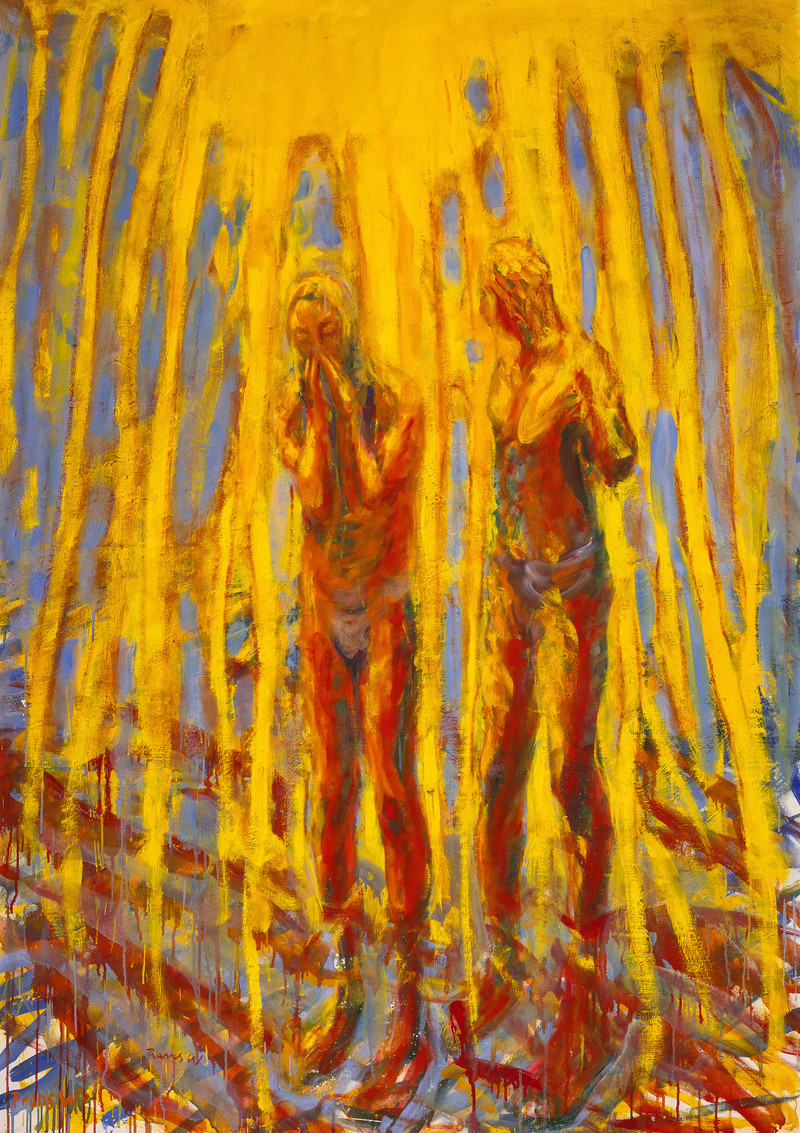
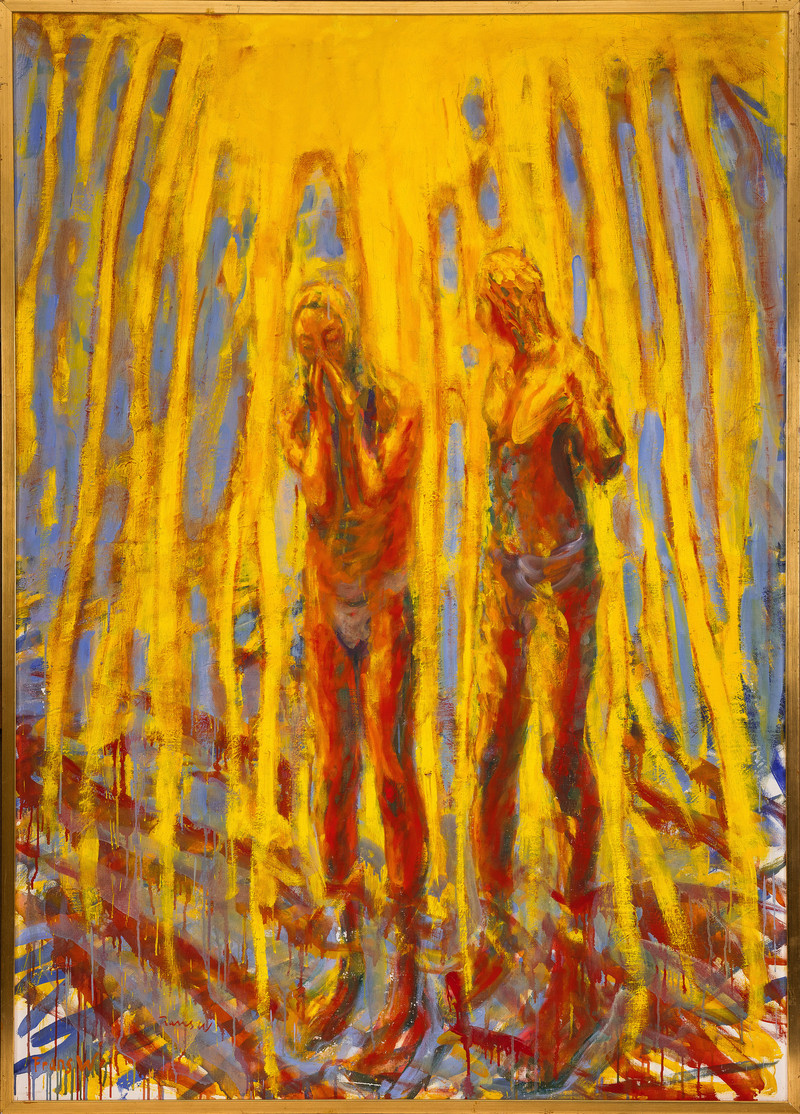
In The Baptism, Widerberg depicts the moment when Jesus is baptised by John the Baptist in the River Jordan, as recounted in the New Testament. The two figures appear almost as though illuminated from within. Through vivid colours and fluid forms, Widerberg lifts the subject beyond its historical setting, transforming it into a universal narrative of renewal and transformation. Light, a recurring theme throughout his artistic career, becomes a symbol of God's presence through the act of baptism. Rather than seeking to portray the event realistically, Widerberg places greater emphasis on conveying its spiritual significance.
When Volsdalen Church was later adorned with a monumental stained-glass window behind the altar, Widerberg’s original altarpieces were placed within a new visual context. The tall stained-glass window, which extends all the way to the church’s roof ridge, introduces a play of colour and light into the space, reinforcing the same themes found in the paintings on either side. Over time, however, a practical issue arose, as the central altarpiece obscured parts of the stained-glass window. To achieve a more harmonious overall composition, the church’s artistic decoration was therefore expanded and reorganised in 2009 with the addition of the painting Madonna and Child. In the new arrangement behind the altar, The Baptism remains a central work, displayed alongside the other paintings and in dialogue with Widerberg’s stained-glass window.
John the Baptist’s Baptism, 1974, is regarded as a preparatory work in Widerberg’s exploration of the subject matter that today forms the altarpiece in Volsdalen Church. The story of John the Baptist baptising Jesus is recognisable through the title, yet Widerberg also invites us, as viewers, to experience the work on our own terms. The colours, light and floating forms encourage reflection on humanity’s search for meaning, community and spiritual belonging. The work encompasses both the Christian narrative and Widerberg’s own exploration of light, energy and humanity’s place within a greater whole.