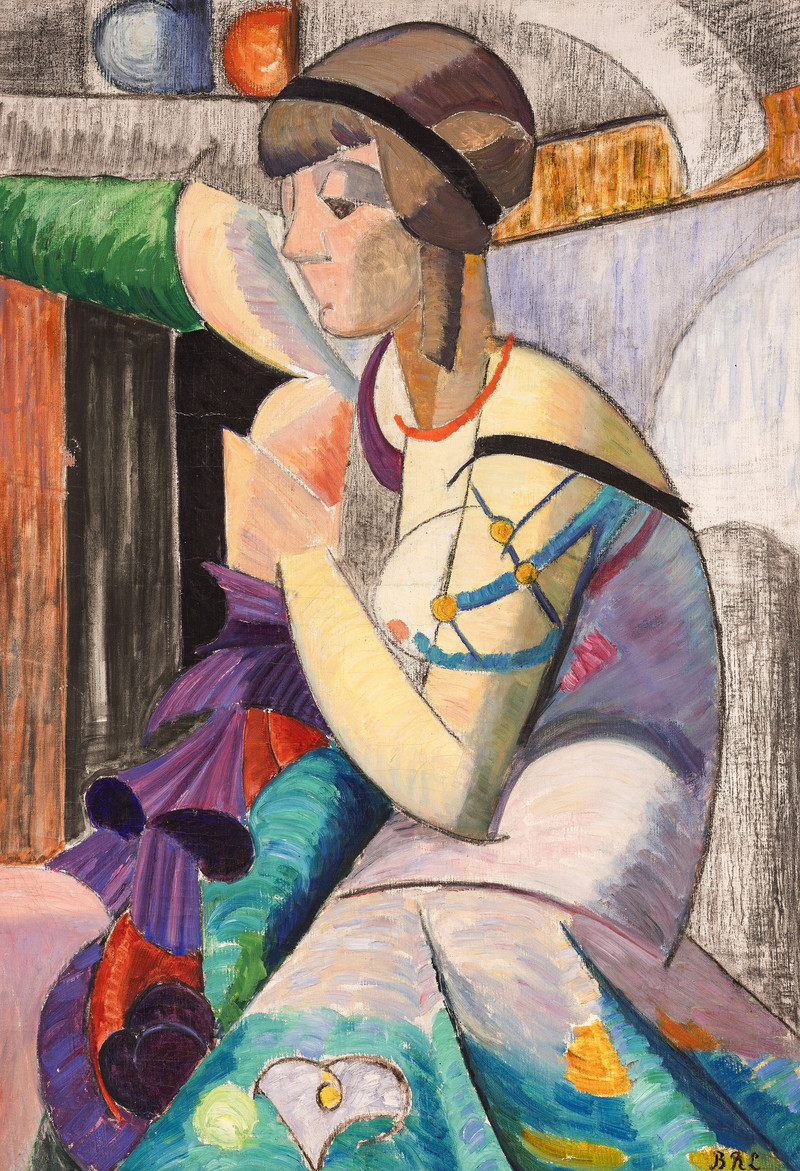
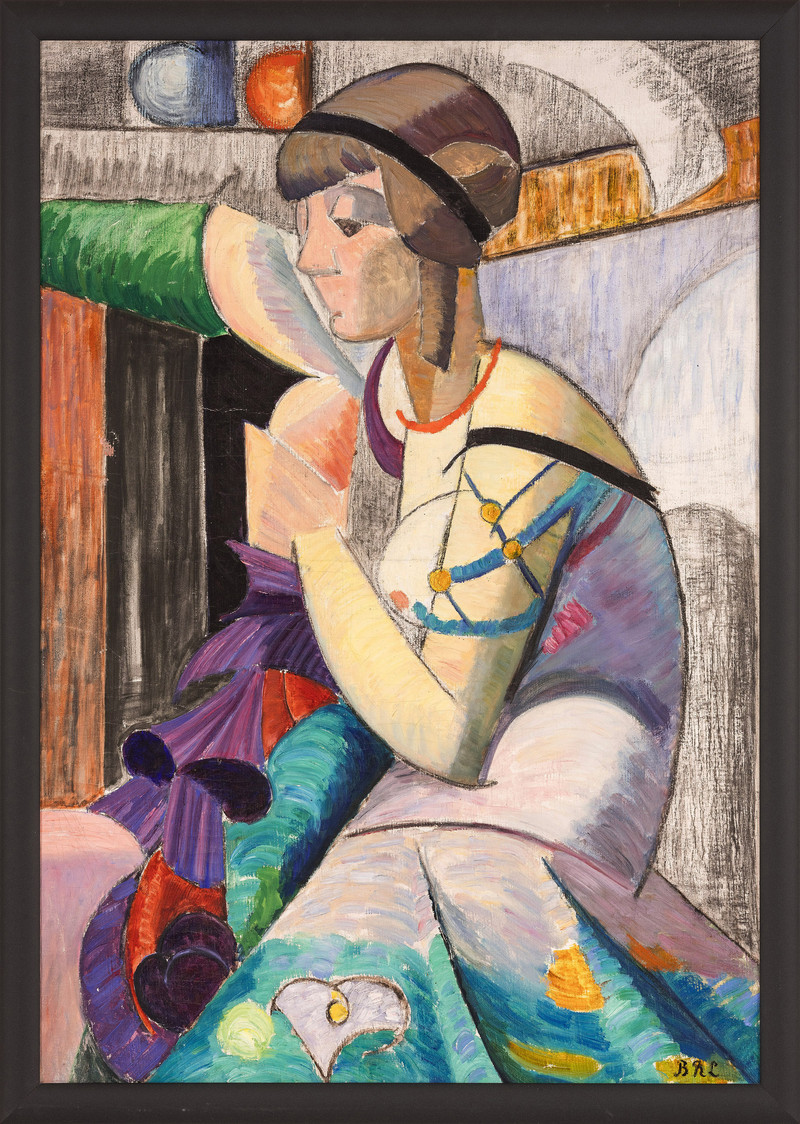
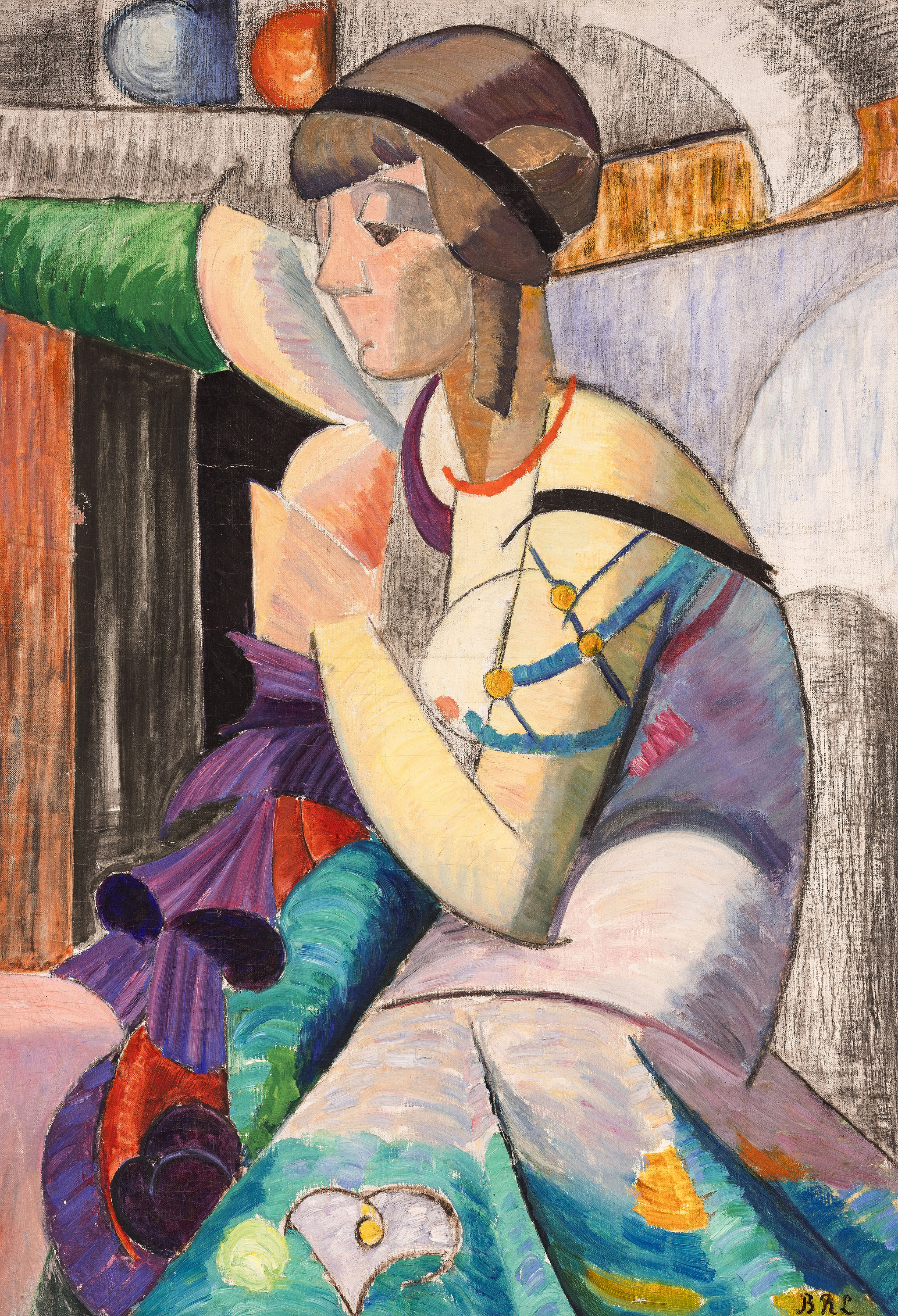
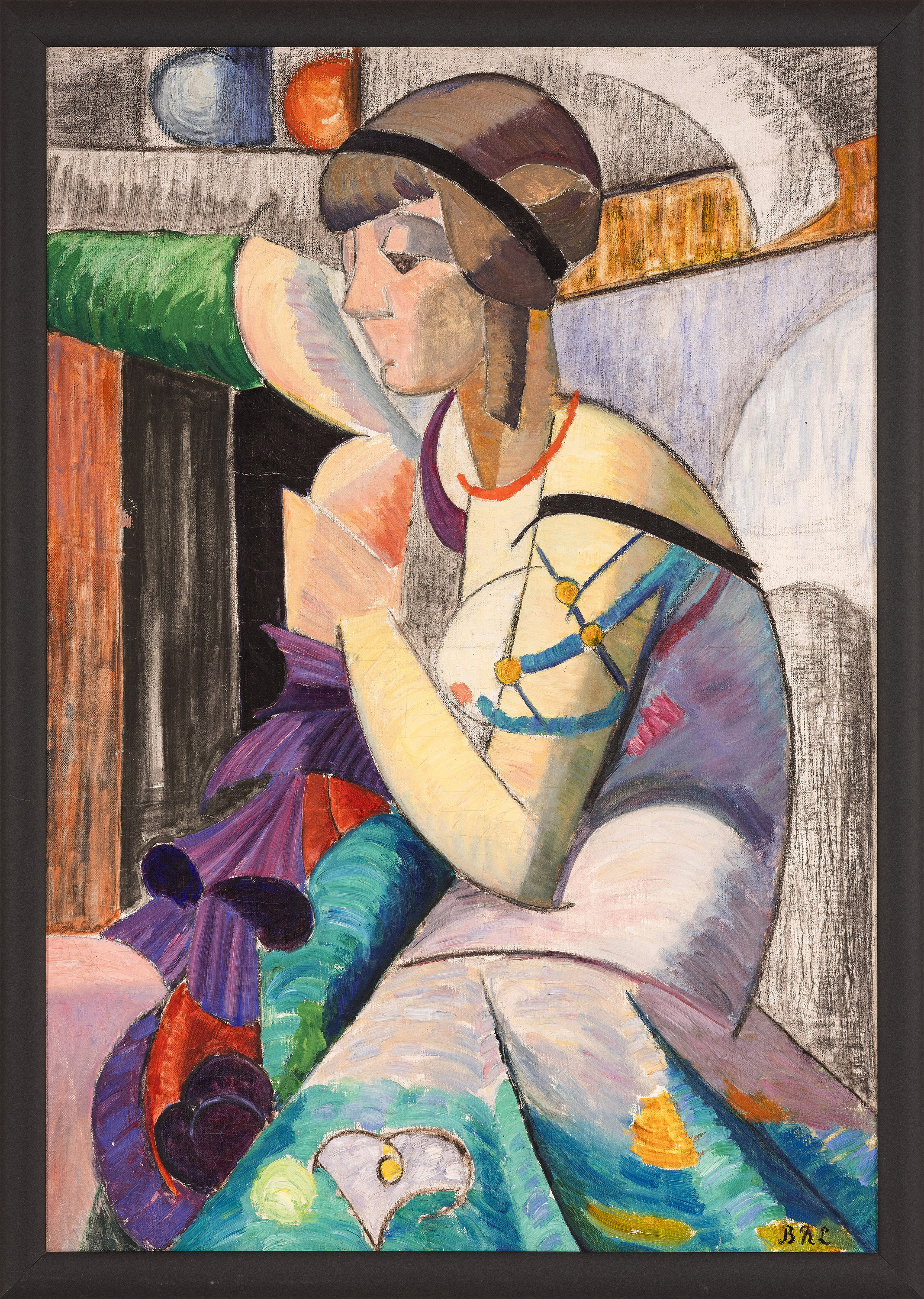
Seated Woman in Festive Dress 1913
Throughout her career, Borghild Røed Lærum (1877–1959) explored a range of artistic approaches. Early on, she experimented with modernist and Cubist techniques before later also developing a more naturalistic visual language. Her exploration of Cubism prior to the First World War places her among the earliest artists to engage with influences from the emerging avant-garde in Paris in the early twentieth century.
From an early age, Røed Lærum showed a keen interest in drawing and painting, producing small landscape studies inspired by her surroundings. The landscapes of her childhood would later become an important part of her artistic output. In 1896, she had the opportunity to travel to England. Her stay strengthened her interest in art, while her encounter with the English countryside provided fresh inspiration. France would later become the most important place for her artistic development.
Harriet Backer’s Teaching
Røed Lærum received her artistic training at Harriet Backer’s painting school in Kristiania (now Oslo). Teaching at Backer’s school placed considerable emphasis on working from live models. Røed Lærum devoted herself to the study of the human body and also attended anatomy courses at the university, presumably to strengthen her artistic skills. Backer’s pedagogical approach was based on close guidance and the continuous correction of her students’ work, with the learning process considered more important than the finished result. When Røed Lærum completed her studies at the school, her teacher praised her highly, highlighting her talent, sense of form and understanding of colour.
In 1901, Røed Lærum made her debut at the Autumn Exhibition (Høstutstillingen) with the painting Forest Study. The work was characterised by a naturalistic style and revealed an artist still working within traditional conventions. During the same period, she travelled to Paris to further develop her artistic practice. This was a courageous choice at a time when pursuing a professional career as an artist was rarely regarded as a viable path for women.
Tradition and Modernism
Over time, Røed Lærum developed her motifs towards a more simplified and modernist visual expression. Figures were often placed against abstracted backgrounds, and the compositions anticipated the artist’s later interest in Cubism. When Røed Lærum moved to Paris in 1912, she came into direct contact with the international avant-garde. She studied at Marie Vassilieff’s academy in Montparnasse, an important meeting place for contemporary modernist artists. The artistic circle surrounding Vassilieff had close connections with artists such as Pablo Picasso, Georges Braque and Henri Matisse.
The paintings Røed Lærum produced between 1912 and 1914 reveal traces of these influences. The compositions became simpler, the picture planes more geometric, and the motifs were approached from a distinctly modernist perspective.
Røed Lærum’s work demonstrates a confident and independent approach to the visual language of modernism. Although modernism is often presented in art-historical literature today as a radical break with the worldviews and traditions of the past, many artists responded to modernity in different ways. A transformed understanding of the world also opened up possibilities for reinterpreting tradition.
This is particularly evident in Seated Woman in Festive Attire, 1913, in which Røed Lærum draws on the tradition of portraiture, which dates back to the Renaissance. The woman is depicted in a three-quarter profile, a compositional device with deep roots in art history. Her figure is largely defined by the turn of her body towards the viewer, and is rendered with a degree of plasticity that remains close to our natural perception of the human form.
The modernist qualities of Røed Lærum’s Seated Woman in Festive Attire, 1913, are most apparent in the Cubist forms of the composition. Repeated geometric shapes, including spheres, rhombuses and funnel-like forms in various colours, create a sense of movement. The woman’s festive attire is rendered with a pronounced sense of materiality, almost allowing us to sense the textures of fabrics that have been crimped, folded and cut on the bias. Indeed, it is largely the dress itself and the ornamental headdress that give the painting its title. The portrait presents a young, liberated woman dressed for a festive occasion in the very latest fashion. At the same time, the painting conveys the tension between tradition and modernism that characterised the early decades of the twentieth century.
When Røed Lærum returned to Paris in 1919, the Cubist influence in her work became more pronounced. There, she studied at André Lhote’s painting school, where teaching combined Cubist simplification of form with classical principles of composition and colour. Drawing played a central role in the training, and students worked with carefully constructed compositions characterised by balance and structure, without necessarily being symmetrical. A distinctive feature of Lhote’s method was the close relationship between figure and surroundings, in which the boundaries between background and subject often dissolve, creating a harmonious whole. Yet, as the pioneer she was, Røed Lærum appears to have already been experimenting with such techniques in Seated Woman in Festive Attire, 1913.